


Page 195 - Semiconductor Manufacturing Handbook
P. 195
Geng(SMH)_CH13.qxd  04/04/2005  19:51  Page 13.18


                                                 PHYSICAL VAPOR DEPOSITION

                   13.18  WAFER PROCESSING


                                     HF/RF    HF/RF
                                      power   matching
                                      supply  network                           Pre-vacuum/
                                                                    Base plate
                                            Cooling water                     loading chamber
                                       Shield                            Target      Conveyor transport
                                                                                         system
                                                                         Aperture
                                   Residual gas
                                    analyzer

                                    Gas inlet


                                       Palette                 Cooling
                                                                water
                                                Vacuum pumps      Load lock             Load lock
                                                             Substrates
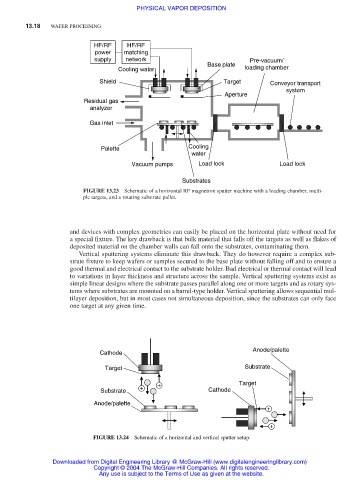
                                   FIGURE 13.23  Schematic of a horizontal RF magnetron sputter machine with a loading chamber, multi-
                                   ple targets, and a rotating substrate pallet.


                               and devices with complex geometries can easily be placed on the horizontal plate without need for
                               a special fixture. The key drawback is that bulk material that falls off the targets as well as flakes of
                               deposited material on the chamber walls can fall onto the substrates, contaminating them.
                                 Vertical sputtering systems eliminate this drawback. They do however require a complex sub-
                               strate fixture to keep wafers or samples secured to the base plate without falling off and to ensure a
                               good thermal and electrical contact to the substrate holder. Bad electrical or thermal contact will lead
                               to variations in layer thickness and structure across the sample. Vertical sputtering systems exist as
                               simple linear designs where the substrate passes parallel along one or more targets and as rotary sys-
                               tems where substrates are mounted on a barrel-type holder. Vertical sputtering allows sequential mul-
                               tilayer deposition, but in most cases not simultaneous deposition, since the substrates can only face
                               one target at any given time.


                                                                                Anode/palette
                                       Cathode
                                        Target                                Substrate

                                                       +                     Target
                                                  +
                                       Substrate                    Cathode
                                     Anode/palette
                                                                                    + +

                                                                                     + +
                                     FIGURE 13.24  Schematic of a horizontal and vertical sputter setup.


                          Downloaded from Digital Engineering Library @ McGraw-Hill (www.digitalengineeringlibrary.com)
                                     Copyright © 2004 The McGraw-Hill Companies. All rights reserved.
                                       Any use is subject to the Terms of Use as given at the website.

