


Page 281 - Semiconductor Manufacturing Handbook
P. 281
Geng(SMH)_CH19.qxd  04/04/2005  20:00  Page 19.8


                                                INSPECTION, MEASUREMENT, AND TEST

                   19.8  FINAL MANUFACTURING

                                 Both are viable business models; however the SCM model has been growing at a faster rate than
                               the IDM model. The value that test vendors can add to the design house is expertise on testing in
                               general and their tester platforms, more specifically, so that a test program can be developed in par-
                               allel with foundry services. The value that the test vendor can add to the foundry is having a diverse
                               geographic network for equipment maintenance and support. Foundries can also supply test devel-
                               opment services.


                   19.2 FUNDAMENTALS OF TEST EQUIPMENT
                   AND MANUFACTURING AUTOMATION SYSTEMS

                   19.2.1 Linking Test to the IC Manufacturing Process
                               IC manufacturing processes are achieving smaller geometries, faster speeds, and lower operational
                               voltages, and this additional complexity has the potential to lower yields and make yields less con-
                               sistent. By taking electrical measurements of specific test structures, the physical properties of the
                               manufacturing process can be extracted independent of the products it produces. These measurement
                               results can then be used to determine if the test devices are physically as they were designed and how
                               the process parameters compare to target values. It is much simpler to extract the physical parame-
                               ters from electrical measurements than to make actual physical measurements at the small geome-
                               tries of a modern IC process.
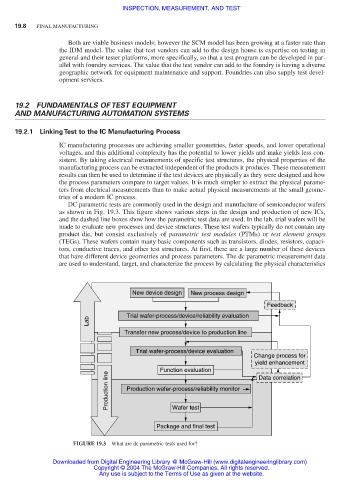
                                 DC parametric tests are commonly used in the design and manufacture of semiconductor wafers
                               as shown in Fig. 19.3. This figure shows various steps in the design and production of new ICs,
                               and the dashed line boxes show how the parametric test data are used. In the lab, trial wafers will be
                               made to evaluate new processes and device structures. These test wafers typically do not contain any
                               product  die, but consist exclusively of  parametric test modules (PTMs) or  test element groups
                               (TEGs). These wafers contain many basic components such as transistors, diodes, resistors, capaci-
                               tors, conductive traces, and other test structures. At first, there are a large number of these devices
                               that have different device geometries and process parameters. The dc parametric measurement data
                               are used to understand, target, and characterize the process by calculating the physical characteristics


                                                   New device design  New process design
                                                                                       Feedback
                                                 Trial wafer-process/device/reliability evaluation
                                       Lab
                                                 Transfer new process/device to production line

                                                    Trial wafer-process/device evaluation
                                                                                    Change process for
                                                                                    yield enhancement
                                                          Function evaluation        Data correlation
                                            Production line  Production wafer-process/reliability monitor


                                                              Wafer test

                                                         Package and final test

                                   FIGURE 19.3  What are dc parametric tests used for?

                             Downloaded from Digital Engineering Library @ McGraw-Hill (www.digitalengineeringlibrary.com)
                                        Copyright © 2004 The McGraw-Hill Companies. All rights reserved.
                                          Any use is subject to the Terms of Use as given at the website.

