


Page 282 - Semiconductor Manufacturing Handbook
P. 282
Geng(SMH)_CH19.qxd  04/04/2005  20:00  Page 19.9


                                                INSPECTION, MEASUREMENT, AND TEST

                                                                         INSPECTION, MEASUREMENT, AND TEST  19.9

                                  from the electrical data. Once the process has been developed to the point where its performance,
                                  reliability, and yield targets have been achieved as verified by using parametric test data, the prod-
                                  uct die can be added and the process can move into the pre-production phase. The PTM areas are
                                  then significantly reduced or removed, with the product die taking their place. For a well-established
                                  process in full production, it is frequently possible to eliminate the PTMs altogether and to have the
                                  parametric test structures reside in the scribe lines between the die. The number of measurements is
                                  also usually reduced since these impact the manufacturing time, but some dc parametric measure-
                                  ments are still done to ensure that major process parameters are on track.
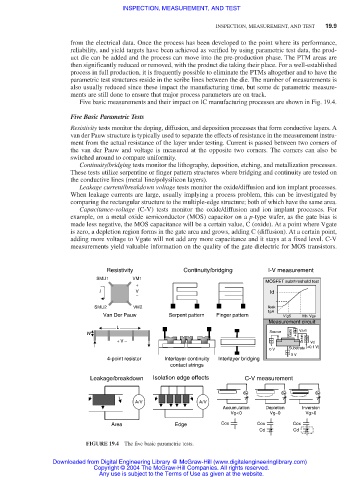
                                    Five basic measurements and their impact on IC manufacturing processes are shown in Fig. 19.4.

                                  Five Basic Parametric Tests
                                  Resistivity tests monitor the doping, diffusion, and deposition processes that form conductive layers. A
                                  van der Pauw structure is typically used to separate the effects of resistance in the measurement instru-
                                  ment from the actual resistance of the layer under testing. Current is passed between two corners of
                                  the van der Pauw and voltage is measured at the opposite two corners. The corners can also be
                                  switched around to compare uniformity.
                                    Continuity/bridging tests monitor the lithography, deposition, etching, and metallization processes.
                                  These tests utilize serpentine or finger pattern structures where bridging and continuity are tested on
                                  the conductive lines (metal line/polysilicon layers).
                                    Leakage current/breakdown voltage tests monitor the oxide/diffusion and ion implant processes.
                                  When leakage currents are large, usually implying a process problem, this can be investigated by
                                  comparing the rectangular structure to the multiple-edge structure; both of which have the same area.
                                    Capacitance-voltage (C-V) tests monitor the oxide/diffusion and ion implant processes. For
                                  example, on a metal oxide semiconductor (MOS) capacitor on a p-type wafer, as the gate bias is
                                  made less negative, the MOS capacitance will be a certain value, C (oxide). At a point where Vgate
                                  is zero, a depletion region forms in the gate area and grows, adding C (diffusion). At a certain point,
                                  adding more voltage to Vgate will not add any more capacitance and it stays at a fixed level. C-V
                                  measurements yield valuable information on the quality of the gate dielectric for MOS transistors.


                                            Resistivity          Continuity/bridging   I-V measurement
                                         SMU1      VM1
                                                                                       MOSFET subthreshold test
                                                    +
                                          I         V                                   Id
                                                    −
                                        SMU2        VM2                                Ileak
                                                                                       1pA
                                           Van Der Pauw      Serpent pattern  Finger pattern  V′gS  Vth Vgs
                                                                                        Measurement circuit
                                               L
                                                                                        Source  Var1
                                      W                                                       Gate
                                               + V −                                             Drain  A  Vd
                                                                                        0 V  Substrate  (<0.1 V)
                                                                                              0 V
                                            4-point resistor  Interlayer continuity  Interlayer bridging
                                                             contact strings
                                       Leakage/breakdown  Isolation edge effects  C-V measurement


                                                    A/V              A/V
                                                                           Accumulation  Depletion  Inversion
                                                                             Vg<0       Vg~0      Vg>0
                                             Area             Edge         Cox       Cox      Cox
                                                                                     Cd       Cd
                                      FIGURE 19.4  The five basic parametric tests.

                             Downloaded from Digital Engineering Library @ McGraw-Hill (www.digitalengineeringlibrary.com)
                                        Copyright © 2004 The McGraw-Hill Companies. All rights reserved.
                                          Any use is subject to the Terms of Use as given at the website.

