


Page 351 - Statistics for Environmental Engineers
P. 351
L1592_frame_C40   Page 361  Tuesday, December 18, 2001  3:24 PM


                                           7.0

                                                    pH = 7.20 - 0.0057 WA
                                           6.5
                                         pH

                                           6.0
                                                               pH = 5.82
                                               pH = 6.93 - 0.0057 WA
                                           5.5
                                             0    100  200  300  400   500  600  700
                                                          Weak Acidity (mg/L)

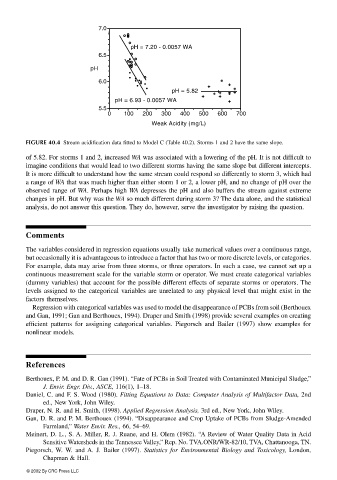
                       FIGURE 40.4 Stream acidification data fitted to Model C (Table 40.2). Storms 1 and 2 have the same slope.

                       of 5.82. For storms 1 and 2, increased WA was associated with a lowering of the pH. It is not difficult to
                       imagine conditions that would lead to two different storms having the same slope but different intercepts.
                       It is more difficult to understand how the same stream could respond so differently to storm 3, which had
                       a range of WA that was much higher than either storm 1 or 2, a lower pH, and no change of pH over the
                       observed range of WA. Perhaps high WA depresses the pH and also buffers the stream against extreme
                       changes in pH. But why was the WA so much different during storm 3? The data alone, and the statistical
                       analysis, do not answer this question. They do, however, serve the investigator by raising the question.


                       Comments

                       The variables considered in regression equations usually take numerical values over a continuous range,
                       but occasionally it is advantageous to introduce a factor that has two or more discrete levels, or categories.
                       For example, data may arise from three storms, or three operators. In such a case, we cannot set up a
                       continuous measurement scale for the variable storm or operator. We must create categorical variables
                       (dummy variables) that account for the possible different effects of separate storms or operators. The
                       levels assigned to the categorical variables are unrelated to any physical level that might exist in the
                       factors themselves.
                        Regression with categorical variables was used to model the disappearance of PCBs from soil (Berthouex
                       and Gan, 1991; Gan and Berthouex, 1994). Draper and Smith (1998) provide several examples on creating
                       efficient patterns for assigning categorical variables. Piegorsch and Bailer (1997) show examples for
                       nonlinear models.


                       References
                       Berthouex, P. M. and D. R. Gan (1991). “Fate of PCBs in Soil Treated with Contaminated Municipal Sludge,”
                           J. Envir. Engr. Div., ASCE, 116(1), 1–18.
                       Daniel, C. and F. S. Wood (1980). Fitting Equations to Data: Computer Analysis of Multifactor Data, 2nd
                           ed., New York, John Wiley.
                       Draper, N. R. and H. Smith, (1998). Applied Regression Analysis, 3rd ed., New York, John Wiley.
                       Gan, D. R. and P. M. Berthouex (1994). “Disappearance and Crop Uptake of PCBs from Sludge-Amended
                           Farmland,” Water Envir. Res., 66, 54–69.
                       Meinert, D. L., S. A. Miller, R. J. Ruane, and H. Olem (1982). “A Review of Water Quality Data in Acid
                           Sensitive Watersheds in the Tennessee Valley,” Rep. No. TVA.ONR/WR-82/10, TVA, Chattanooga, TN.
                       Piegorsch,  W.  W. and A. J. Bailer (1997).  Statistics for Environmental Biology and  Toxicology, London,
                           Chapman & Hall.
                       © 2002 By CRC Press LLC

