


Page 487 - The Mechatronics Handbook
P. 487
0066_frame_C19  Page 109  Wednesday, January 9, 2002  5:32 PM


                                                    Wiper
                                                                 Output
                                                                 Voltage


                                                Potentiometer Wires  Displacement
                                             A                 B
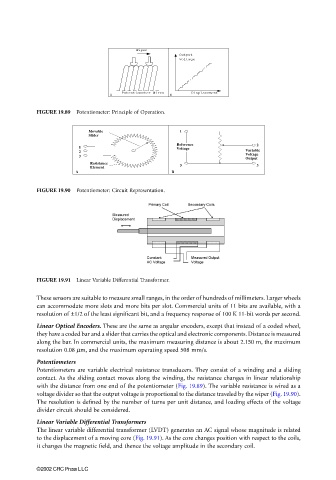
                       FIGURE 19.89  Potentiometer: Principle of Operation.


                                      Movable                     1
                                      Slider
                                                                 Reference               2
                                   1
                                   2                             Voltage             Variable
                                   3                                                 Voltage
                                                                                     Output
                                       Resistance
                                       Element                    3                      3
                                  A                            B
                       FIGURE 19.90  Potentiometer: Circuit Representation.


                       FIGURE 19.91  Linear Variable Differential Transformer.


                       These sensors are suitable to measure small ranges, in the order of hundreds of millimeters. Larger wheels
                       can accommodate more slots and more bits per slot. Commercial units of 11 bits are available, with a
                       resolution of ±1/2 of the least significant bit, and a frequency response of 100 K 11-bit words per second.
                       Linear Optical Encoders. These are the same as angular encoders, except that instead of a coded wheel,
                       they have a coded bar and a slider that carries the optical and electronic components. Distance is measured
                       along the bar. In commercial units, the maximum measuring distance is about 2.150 m, the maximum
                       resolution 0.08 µm, and the maximum operating speed 508 mm/s.
                       Potentiometers
                       Potentiometers are variable electrical resistance transducers. They consist of a winding and a sliding
                       contact. As the sliding contact moves along the winding, the resistance changes in linear relationship
                       with the distance from one end of the potentiometer (Fig. 19.89). The variable resistance is wired as a
                       voltage divider so that the output voltage is proportional to the distance traveled by the wiper (Fig. 19.90).
                       The resolution is defined by the number of turns per unit distance, and loading effects of the voltage
                       divider circuit should be considered.
                       Linear Variable Differential Transformers
                       The linear variable differential transformer (LVDT) generates an AC signal whose magnitude is related
                       to the displacement of a moving core (Fig. 19.91). As the core changes position with respect to the coils,
                       it changes the magnetic field, and thence the voltage amplitude in the secondary coil.


                       ©2002 CRC Press LLC

