


Page 859 - Advanced Organic Chemistry Part A - Structure and Mechanisms, 5th ed (2007) - Carey _ Sundberg
P. 859
The presence of a t-butyl substituent on both C(2) and C(3), however, prevents      843
          attainment of the s-cis conformation, and D-A reactions of 2,3-di-(t-butyl)-1,3-
          butadiene have not been observed. 16                                           SECTION 10.2
                                                                                   The Diels-Alder Reaction


          10.2.2. Substituent Effects on Reactivity, Regioselectivity and Stereochemistry

              There is a strong electronic substituent effect on the D-A cycloaddition. It
          has long been known that the reaction is particularly efficient and rapid when the
          dienophile contains one or more EWG and is favored still more if the diene also
          contains an ERG. Thus, among the most reactive dienophiles are quinones, maleic
          anhydride, and nitroalkenes. 	,ß-Unsaturated esters, ketones, and nitriles are also
          effective dienophiles. The D-A reaction between unfunctionalized alkenes and dienes
          is quite slow. For example, the reaction of cyclopentadiene and ethene occurs at around
                17

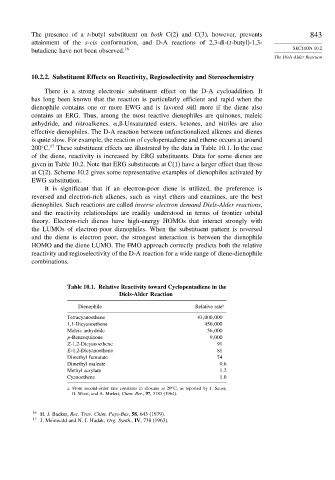
          200 C. These substituent effects are illustrated by the data in Table 10.1. In the case
          of the diene, reactivity is increased by ERG substituents. Data for some dienes are
          given in Table 10.2. Note that ERG substituents at C(1) have a larger effect than those
          at C(2). Scheme 10.2 gives some representative examples of dienophiles activated by
          EWG substitution.
              It is significant that if an electron-poor diene is utilized, the preference is
          reversed and electron-rich alkenes, such as vinyl ethers and enamines, are the best
          dienophiles. Such reactions are called inverse electron demand Diels-Alder reactions,
          and the reactivity relationships are readily understood in terms of frontier orbital
          theory. Electron-rich dienes have high-energy HOMOs that interact strongly with
          the LUMOs of electron-poor dienophiles. When the substituent pattern is reversed
          and the diene is electron poor, the strongest interaction is between the dienophile
          HOMO and the diene LUMO. The FMO approach correctly predicts both the relative
          reactivity and regioselectivity of the D-A reaction for a wide range of diene-dienophile
          combinations.


                     Table 10.1. Relative Reactivity toward Cyclopentadiene in the
                                     Diels-Alder Reaction
                         Dienophile                         Relative rate a
                     Tetracyanoethene                       43 000 000
                     1,1-Dicyanoethene                        450 000
                     Maleic anhydride                          56 000
                     p-Benzoquinone                             9 000
                     Z-1,2-Dicyanoethene                          91
                     E-1,2-Dicyanoethene                          81
                     Dimethyl fumarate                            74
                     Dimethyl maleate                              0 6
                     Methyl acrylate                               1 2
                     Cyanoethene                                   1 0
                                                     o
                     a. From second-order rate constants in dioxane at 20 C, as reported by J. Sauer,
                       H. Wiest, and A. Mielert, Chem. Ber., 97, 3183 (1964).

           16   H. J. Backer, Rec. Trav. Chim. Pays-Bas, 58, 643 (1939).
           17
             J. Meinwald and N. J. Hudak, Org. Synth., IV, 738 (1963).

