


Page 1246 - Advanced Organic Chemistry Part B - Reactions & Synthesis
P. 1246
1222             Scheme 13.60. Epothilone A Synthesis by Olefin Metathesis: K. C. Nicolaou and Co-
                                                      Workers a
      CHAPTER 13
                                           A
      Multistep Syntheses
                                     1) (Ipc) 2 BCH CH  CH 2             O  CH
                                              2
                                     2) TBDMSOTf, lut               B
                              CH  O                            CO H
                                                                 2
                                     3) O , PPh 3
                                        3
                           O                            O  OTBDMS
                                     4) NaClO 2                     LDA
                                             C
                                          1) DiBAlH
                                  S    2) Ph P  CCH  O            S
                                           3
                                                                       HO
                                              CH 3                N
                                  N
                          H O C
                        C 2 2  2     3) (Ipc) BCH CH  CH 2                             H
                                           2
                                               2
                                                          OH                        CO 2
                                                                  D          O   OTBDMS
                                                                   1) DCCI
                                                                   2) DMAP
                                               S
                                                                                        S
                       HO
                                               N        E       HO
                                                                                        N
                                      O        PhCH  Ru[P(c-Hex) ] Cl 2
                                                              3 2
                                                                               O
                             O
                                 O  O             F                   O      O
                            TBDMS                                 O
                                                1) TFA                       S
                                       2) MCPBA      HO
                                                                             N
                                                                    O
                                                           O      O
                                                               OH
                       a. Z. Yang, Y. He, D. Vourloumis, H. Vallberg, and K. C. Nicolaou, Angew. Chem. Int. Ed. Engl., 36, 166 (1997).
                       This synthesis is shown in Scheme 13.59. Two enantiomerically pure starting materials
                       were brought together by a Wittig reaction in Step C. The aldol addition in Step D was
                       diastereoselective for the anti configuration, but gave a 1:1 mixture with the 6S 7R-
                       diastereomer. The stereoisomers were separated after Step E-2. The macrolactonization
                       (Step E-4) was accomplished by a mixed anhydride (see Section 3.4.1). The final
                       epoxidation was done using 3-methyl-3-trifluoromethyl dioxirane.
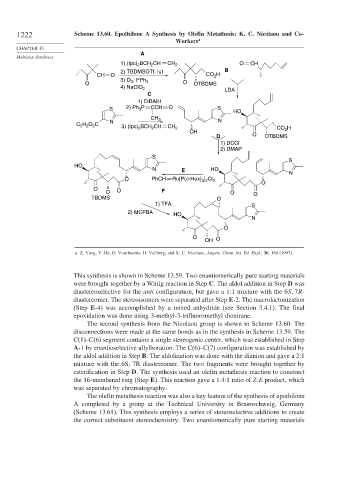
                           The second synthesis from the Nicolaou group is shown in Scheme 13.60. The
                       disconnections were made at the same bonds as in the synthesis in Scheme 13.59. The
                       C(1)–C(6) segment contains a single stereogenic center, which was established in Step
                       A-1 by enantioselective allylboration. The C(6)–C(7) configuration was established by
                       the aldol addition in Step B. The aldolization was done with the dianion and gave a 2:1
                       mixture with the 6S, 7R diastereomer. The two fragments were brought together by
                       esterification in Step D. The synthesis used an olefin metathesis reaction to construct
                       the 16-membered ring (Step E). This reaction gave a 1.4:1 ratio of Z:E product, which
                       was separated by chromatography.
                           The olefin metathesis reaction was also a key feature of the synthesis of epothilone
                       A completed by a group at the Technical University in Braunschweig, Germany
                       (Scheme 13.61). This synthesis employs a series of stereoselective additions to create
                       the correct substituent stereochemistry. Two enantiomerically pure starting materials

