


Page 538 - Aircraft Stuctures for Engineering Student
P. 538
12.8 Finite element method for continuum structures  519

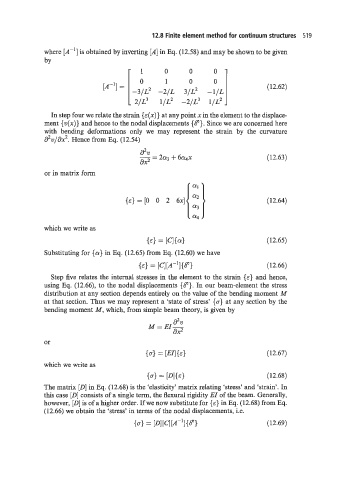
              where [A-'1 is obtained by inverting [A] in Eq. (12.58) and may be shown to be given
              by
                                       I o        0      0      01
                                       r
                                          1
                                                  1
                                                         0
                               [A-'I  =   -3/L2   -2/L   3/L2   -1/L            (12.62)
                                       1 2/L3   1/L2  -2/L3    1/Lq
                In step four we relate the strain {E(.)}   at any point x in the element to the displace-
              ment {.(.)}   and hence to the nodal displacements {g}. Since we are concerned here
              with  bending  deformations  only  we  may  represent  the  strain  by  the  curvature
              a2w/dx2. Hence from Eq. (12.54)

                                                                                (12.63)

              or in matrix form


                                                                                (12.64)


              which we write as

                                            {E>  = [Cl{a)                       (12.65)
              Substituting for {a} in Eq. (12.65) from Eq. (12.60) we have
                                          {E} = [cI[A-'l{@}                     (12.66)
                Step five relates the internal stresses in the element to the strain  {E}  and hence,
              using Eq. (12.66), to the nodal displacements (6"). In our beam-element the stress
              distribution at any section depends entirely on the value of the bending moment M
              at that section. Thus we may represent a 'state of stress' {a} at any section by  the
              bending moment M, which, from simple beam theory, is given by

                                                    a2W
                                             M=EI-  ax2


                                                                                (12.67)


                                            {a} = [DI{E)                        (12.68)
              The matrix [D] in Eq. (12.68) is the 'elasticity' matrix relating 'stress' and 'strain'.  In
              this case [D] consists of a single term, the flexural rigidity EI of the beam. Generally,
              however, [D] is of a higher order. If we now substitute for {E} in Eq. (12.68) from Eq.
              (12.66) we obtain the 'stress' in terms of the nodal displacements, i.e.
                                         {a> = [Dl[cl[A-'l{@)                   (12.69)

