


Page 539 - Aircraft Stuctures for Engineering Student
P. 539
520  Matrix methods of structural analysis

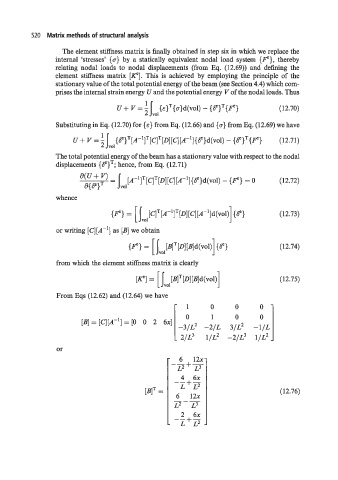
                   The element stiffness matrix is finally obtained in step six in which we replace the
                 internal 'stresses'  {a} by  a  statically equivalent nodal load  system {Fe}, thereby
                 relating nodal  loads  to  nodal displacements (from Eq.  (12.69))  and  defining the
                 element stiffness matrix  [IC]. This is  achieved by  employing the principle of  the
                 stationary value of the total potential energy of the beam (see Section 4.4) which com-
                 prises the internal strain energy U and the potential energy V of the nodal loads. Thus
                                            1
                                    U + V = -   {&}T{a}d(Vol) - {6"}T{F'}          (12.70)
                                            2 1.1
                  Substituting in Eq. (12.70) for {E} from Eq. (12.66) and {a} from Eq. (12.69) we have
                               1
                       U + I/ = -  {6"}T[A-']T[~T[D][~[A-1]{~}d(~~l) {a"}T{Fe}     (12.71)
                                                                    -
                               2 Iv0l
                 The total potential energy of the beam has a stationary value with respect to the nodal
                 displacements {6"}T; hence, from Eq. (12.71)
                         a(u+ V)
                                       [A-']T[CIT[D][q[A-1]{6e}d(~~1) {Fe} = 0      (12.72)
                                                                   -
                  whence

                                                                                    (12.73)

                  or writing [C][A-'] as [B] we obtain

                                                                                    (12.74)

                  from which the element stiffness matrix is clearly

                                                                                    (12.75)
                                         [K"I = [ J vol ~~lT[ol~~l~~~~~)]
                  From Eqs (12.62) and (12.64) we have
                                                        1      0      0
                                                        0      1      0
                         [B]  = [q[A-']  = [O  0  2  6x1
                                                      -3/L2   -2/L   3/L2   -1/L
                                                      21~3    ip.2  -21~3  i/L2

                  or
                                                     L2 +z
                                                  -  6    12x
                                                    -_
                                                      4  6x
                                                     --+_
                                                      L  L2
                                            [BIT =                                  (12.76)
                                                     6   12x
                                                    L2   L3

