


Page 709 - 02. Subyek Computer Aided Design - Beginner’s Guide to SOLIDWORKS 2019- Level 1 by Alejandro Reyes
P. 709
Beginner's Guide to SOLIDWORKS 2019- Level I


                                                      It is important to know that, by the very nature of the Finite Element

                                                1
                                                      Analysis  process,  the  results  are  an  approximation  to  the  actual


                                                      physical  phenomenon  and  solving  such  a  large  number  of


                                    simultaneous equations will most likely return slightly different values for


                                    stress and displacement results. However, the resulting values should be, in


                                    general,  very close  to the  results  shown  in  this  book,  assuming that the


                                    analysis is defined the same way {geometry, material, loads, and restraints)


                                    and the mesh size is the same.


                                                      The accuracy of any analysis will depend on how well the geometry is


                                    modeled, as well as how closely material properties, loading, mesh size, and


                                    restraining  conditions  match  the  actual  physical  conditions.  An  analysis


                                    done with SimulationXpress should only be considered as a general guide


                                    and never a substitute for a complete and properly modeled analysis using


                                    accurate loading and restraining conditions.


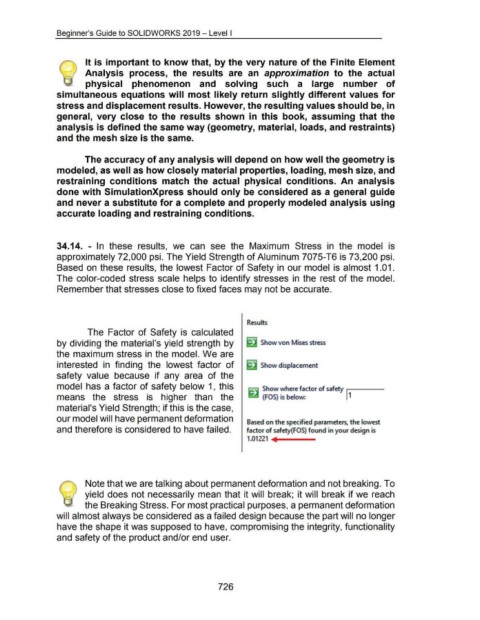
                                    34.14.  - In  these  results,  we  can  see  the  Maximum  Stress  in  the  model  is


                                    approximately 72,000 psi. The Yield Strength of Aluminum 7075-T6 is 73,200 psi.


                                    Based on these results, the  lowest Factor of Safety in  our model  is almost 1.01.


                                    The  color-coded  stress scale  helps to  identify stresses  in  the  rest of the  model.


                                    Remember that stresses close to fixed faces may not be accurate.


                                                                                                                                                           Results


                                                        The  Factor of Safety is  calculated


                                    by dividing the material's yield strength  by


                                    the maximum stress in the model. We are


                                    interested  in  finding  the  lowest  factor  of


                                    safety  value  because  if  any  area  of  the


                                    model  has a factor of safety below 1 , this                                                                                     Show where factor of safety J


                                    means  the  stress  is  higher  than  the                                                                               ~ (FOS) is below:                                              1


                                    material's Yield Strength; if this is the case,


                                    our model will have permanent deformation                                                                               Based on the specified parameters, the lowest


                                    and therefore is considered to have failed.                                                                            factor of safety(FOS) found in your design is

                                                                                                                                                           1.01221  ... __ _


                                                      Note that we are talking about permanent deformation and not breaking. To
                                                1
                                                      yield  does not necessarily mean that it will  break;  it will  break if we reach


                                                      the Breaking Stress. For most practical purposes, a permanent deformation


                                    will almost always be considered as a failed design because the part will no longer


                                    have the shape it was supposed to have, compromising the integrity, functionality


                                    and safety of the product and/or end user.


                                                                                                                                         726

