


Page 463 - Cascade_Biocatalysis_Integrating_Stereoselective_and_Environmentally_Friendly_Reactions
P. 463
19.4 Combination of Substrate Synthesis and Derivatization Step(s)  439

               second step, one has to keep in mind that in this case the reaction mixture resulting
               from the first step must be compatible with the enzyme and biotransformation. The
               development of compatible reaction steps often turned out to be a key challenge in
               the development of such types of one-pot processes.

               19.4.1
               One-Pot Processes with an Initial Biocatalytic Step, Followed by Chemocatalysis or a
               Noncatalyzed Chemical Process

               To start with the first option of such a chemoenzymatic process sequence, namely
               initial biotransformation and subsequent chemocatalytic or classical chemical
               reaction(s), an early example from the Gijsen and Wong [40] already in 1995
               demonstrated a one-pot process for the synthesis of a cyclitol, which is based on an
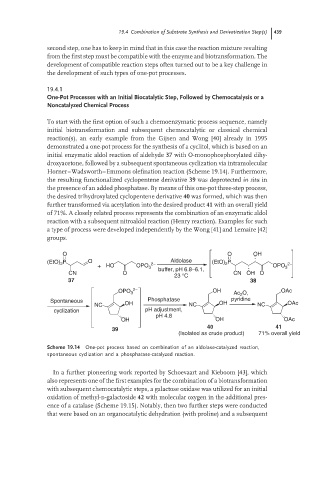
               initial enzymatic aldol reaction of aldehyde 37 with O-monophosphorylated dihy-
               droxyacetone, followed by a subsequent spontaneous cyclization via intramolecular
               Horner–Wadsworth–Emmons olefination reaction (Scheme 19.14). Furthermore,
               the resulting functionalized cyclopentene derivative 39 was deprotected in situ in
               the presence of an added phosphatase. By means of this one-pot three-step process,
               the desired trihydroxylated cyclopentene derivative 40 was formed, which was then
               further transformed via acetylation into the desired product 41 with an overall yield
               of 71%. A closely related process represents the combination of an enzymatic aldol
               reaction with a subsequent nitroaldol reaction (Henry reaction). Examples for such
               a type of process were developed independently by the Wong [41] and Lemaire [42]
               groups.

                   O                                               O      OH
               (EtO) 2 P  O                  2−   Aldolase    (EtO) 2 P             2−
                             +  HO      OPO 3                                   OPO 3
                                               buffer, pH 6.8–6.1,
                     CN             O                               CN OH O
                                                   23 °C
                     37                                                  38
                                       2−
                                   OPO 3                      OH    Ac 2 O,       OAc
                Spontaneous                 Phosphatase             pyridine
                            NC       OH                NC       OH         NC       OAc
                 cyclization               pH adjustment,
                                              pH 4.8
                                    OH                         OH                  OAc
                                                             40                 41
                                 39
                                                    (Isolated as crude product)  71% overall yield
               Scheme 19.14 One-pot process based on combination of an aldolase-catalyzed reaction,
               spontaneous cyclization and a phosphatase-catalyzed reaction.
                In a further pioneering work reported by Schoevaart and Kieboom [43], which
               also represents one of the first examples for the combination of a biotransformation
               with subsequent chemocatalytic steps, a galactose oxidase was utilized for an initial
               oxidation of methyl-d-galactoside 42 with molecular oxygen in the additional pres-
               ence of a catalase (Scheme 19.15). Notably, then two further steps were conducted
               that were based on an organocatalytic dehydration (with proline) and a subsequent

