


Page 239 - Earth's Climate Past and Future
P. 239
CHAPTER 12 • Last Glacial Maximum  215


                                                            lent atmosphere that carried dust farther south than
                                                            today.
                                                               Almost everywhere we look, evidence shows that
                                                            more debris was blowing across Earth’s surface in the
                                                            glacial world. One way of testing climate model simula-
                                                            tions of the last glacial maximum is to examine the
                                                            distribution of various kinds of debris carried by winds,
                                                            ranging from desert sands to windblown silts (loess) and
                                                            fine (clay-sized) dust. Because climate models can simu-
                                                            late the strength and direction of winds from the
                                                            surface up to jet stream altitudes, the potential exists to
                            Loess deposits                  compare model simulations with the observed patterns
                                                            of windblown glacial debris.
                                                               Unfortunately, even though the current generation
        FIGURE 12-4 Glacial maximum loess Ice sheets and
        mountain glaciers eroded large amounts of debris of all sizes  of climate models does a fairly good job of simulating
        and carried it to their margins. Winds picked up silt-sized loess  the large-scale circulation of the atmosphere, the mod-
        and deposited it downwind of these sources. (Adapted from K.  els do not do as good a job at the smaller scales needed
        Pye, “Loess,” Progress in Physical Geography 8 [1984]: 176–217.)  to simulate dust transport. The models are less success-
                                                            ful at simulating the processes that actually lift and
                                                            transport silt and dust from Earth’s surface, such as local
                                                            wind gusts along frontal systems or small-scale eddies of
        than nearby North America. Glacial ice also contains  wind.
                       –
                +
        more Na and Cl ions, an indication that far more salt
        was lifted from stormy glacial sea surfaces and deposited
        in the ice then than today.
           Dust transport was also greater at lower latitudes
        during the last glacial maximum. Today the North                                             North
                                                                                                     tropic
        African and Arabian deserts and their semiarid margins
        produce some of the largest dust storms on Earth. By
        comparison, sediment cores from the Indian Ocean east
        of the Arabian Peninsula show that dust accumulated                        Equator
        five times faster during the last glacial maximum and
        during several previous glaciations than it does today.                  South tropic
        Cores from the equatorial Atlantic Ocean reveal that
        dust was also deposited in that region at higher rates
        during glaciations.
           The extremely arid cores of the deserts were also  A  Sand dunes active today
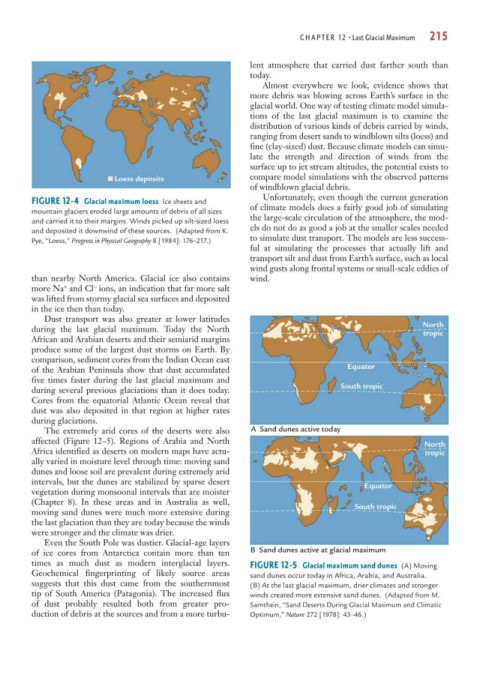
        affected (Figure 12–5). Regions of Arabia and North                                          North
        Africa identified as deserts on modern maps have actu-                                       tropic
        ally varied in moisture level through time: moving sand
        dunes and loose soil are prevalent during extremely arid
        intervals, but the dunes are stabilized by sparse desert                       Equator
        vegetation during monsoonal intervals that are moister
        (Chapter 8). In these areas and in Australia as well,                        South tropic
        moving sand dunes were much more extensive during
        the last glaciation than they are today because the winds
        were stronger and the climate was drier.
           Even the South Pole was dustier. Glacial-age layers
        of ice cores from Antarctica contain more than ten  B  Sand dunes active at glacial maximum
        times as much dust as modern interglacial layers.   FIGURE 12-5 Glacial maximum sand dunes (A) Moving
        Geochemical fingerprinting of likely source areas   sand dunes occur today in Africa, Arabia, and Australia.
        suggests that this dust came from the southernmost  (B) At the last glacial maximum, drier climates and stronger
        tip of South America (Patagonia). The increased flux  winds created more extensive sand dunes. (Adapted from M.
        of dust probably resulted both from greater pro-    Sarnthein, “Sand Deserts During Glacial Maximum and Climatic
        duction of debris at the sources and from a more turbu-  Optimum,” Nature 272 [1978]: 43–46.)

