


Page 240 - Earth's Climate Past and Future
P. 240
216     PART IV • Deglacial Climate Change


        Testing Model Simulations against                      The COHMAP researchers then ran model simula-
        Biotic Data                                         tions of climate at intervals of several thousand years
                                                            between the glacial maximum and the present to deter-
        So far, we have examined only the physical aspects (ice  mine how changes in the major boundary conditions
        and dirt) of the glacial maximum world. But living  drove regional patterns of climate change. The
        organisms also have a story to tell. They also allow us to  COHMAP team focused on the role of orbital-scale
        test the performance of climate models on a world quite  changes in climate over intervals of thousands of years,
        different from ours.                                rather than on shorter-term fluctuations superimposed
                                                            on this gradual trend.
        12-4 COHMAP: Data-Model Comparisons                    The climate data produced as output from these
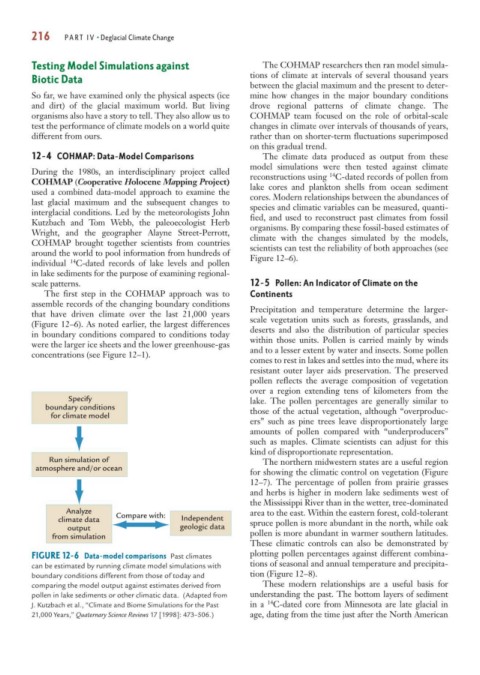
                                                            model simulations were then tested against climate
        During the 1980s, an interdisciplinary project called  reconstructions using  C-dated records of pollen from
                                                                               14
        COHMAP (Cooperative Holocene Mapping Project)       lake cores and plankton shells from ocean sediment
        used a combined data-model approach to examine the  cores. Modern relationships between the abundances of
        last glacial maximum and the subsequent changes to  species and climatic variables can be measured, quanti-
        interglacial conditions. Led by the meteorologists John  fied, and used to reconstruct past climates from fossil
        Kutzbach and Tom Webb, the paleoecologist Herb      organisms. By comparing these fossil-based estimates of
        Wright, and the geographer Alayne Street-Perrott,   climate with the changes simulated by the models,
        COHMAP brought together scientists from countries   scientists can test the reliability of both approaches (see
        around the world to pool information from hundreds of  Figure 12–6).
        individual  C-dated records of lake levels and pollen
                 14
        in lake sediments for the purpose of examining regional-
        scale patterns.                                     12-5 Pollen: An Indicator of Climate on the
           The first step in the COHMAP approach was to     Continents
        assemble records of the changing boundary conditions
        that have driven climate over the last 21,000 years  Precipitation and temperature determine the larger-
        (Figure 12–6). As noted earlier, the largest differences  scale vegetation units such as forests, grasslands, and
        in boundary conditions compared to conditions today  deserts and also the distribution of particular species
        were the larger ice sheets and the lower greenhouse-gas  within those units. Pollen is carried mainly by winds
        concentrations (see Figure 12–1).                   and to a lesser extent by water and insects. Some pollen
                                                            comes to rest in lakes and settles into the mud, where its
                                                            resistant outer layer aids preservation. The preserved
                                                            pollen reflects the average composition of vegetation
                                                            over a region extending tens of kilometers from the
                 Specify                                    lake. The pollen percentages are generally similar to
            boundary conditions                             those of the actual vegetation, although “overproduc-
             for climate model
                                                            ers” such as pine trees leave disproportionately large
                                                            amounts of pollen compared with “underproducers”
                                                            such as maples. Climate scientists can adjust for this
                                                            kind of disproportionate representation.
            Run simulation of                                  The northern midwestern states are a useful region
         atmosphere and/or ocean
                                                            for showing the climatic control on vegetation (Figure
                                                            12–7). The percentage of pollen from prairie grasses
                                                            and herbs is higher in modern lake sediments west of
                                                            the Mississippi River than in the wetter, tree-dominated
                 Analyze                                    area to the east. Within the eastern forest, cold-tolerant
               climate data  Compare with:  Independent     spruce pollen is more abundant in the north, while oak
                 output                    geologic data
             from simulation                                pollen is more abundant in warmer southern latitudes.
                                                            These climatic controls can also be demonstrated by
        FIGURE 12-6 Data-model comparisons Past climates    plotting pollen percentages against different combina-
        can be estimated by running climate model simulations with  tions of seasonal and annual temperature and precipita-
        boundary conditions different from those of today and  tion (Figure 12–8).
        comparing the model output against estimates derived from  These modern relationships are a useful basis for
        pollen in lake sediments or other climatic data. (Adapted from  understanding the past. The bottom layers of sediment
                                                                14
        J. Kutzbach et al., “Climate and Biome Simulations for the Past  in a  C-dated core from Minnesota are late glacial in
        21,000 Years,” Quaternary Science Reviews 17 [1998]: 473–506.)  age, dating from the time just after the North American

