


Page 154 - Electromechanical Devices and Components Illustrated Sourcebook
P. 154
116 Electromechanical Devices & Components Illustrated Sourcebook

        Translating Rotary Motion                                         Guide Bearing    Preload Spring
                                                                  Antibacklash Element
                                                                                             Drive Nut
        to Linear Motion                                        Lead Screw

        Motion control most often means controlling linear motion.
        Since motors produce rotary motion, some sort of linear
        conversion must take place. The most common method is to
        couple the output of the motor to a threaded shaft, or lead
        screw.
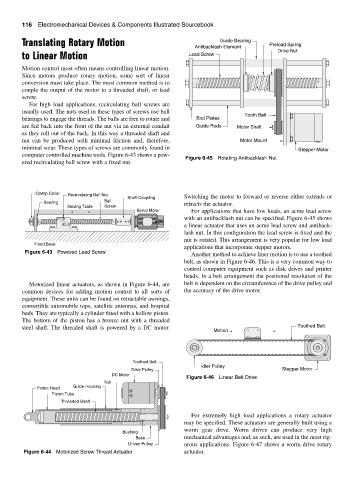
           For high load applications, recirculating ball screws are
        usually used. The nuts used in these types of screws use ball
                                                                                  Tooth Belt
        bearings to engage the threads. The balls are free to rotate and  End Plates
        are fed back into the front of the nut via an external conduit  Guide Rods  Motor Shaft
        as they roll out of the back. In this way a threaded shaft and
        nut can be produced with minimal friction and, therefore,                Motor Mount
        minimal wear. These types of screws are commonly found in                                   Stepper Motor
        computer controlled machine tools. Figure 6-43 shows a pow-
                                                               Figure 6-45 Rotating Antibacklash Nut
        ered recirculating ball screw with a fixed nut.


             Clamp Collar
                        Recirculating Ball Nut
                                           Shaft Coupling     Switching the motor to forward or reverse either extends or
                Bearing             Ball                      retracts the actuator.
                       Moving Table  Screw
                                               Servo Motor       For applications that have low loads, an acme lead screw
                                                              with an antibacklash nut can be specified. Figure 6-45 shows
                                                              a linear actuator that uses an acme lead screw and antiback-
                                                              lash nut. In this configuration the lead screw is fixed and the
                                                              nut is rotated. This arrangement is very popular for low load
            Fixed Base
                                                              applications that incorporate stepper motors.
         Figure 6-43 Powered Lead Screw
                                                                 Another method to achieve liner motion is to use a toothed
                                                              belt, as shown in Figure 6-46. This is a very common way to
                                                              control computer equipment such as disk drives and printer
                                                              heads. In a belt arrangement the positional resolution of the
           Motorized linear actuators, as shown in Figure 6-44, are  belt is dependent on the circumference of the drive pulley and
        common devices for adding motion control to all sorts of  the accuracy of the drive motor.
        equipment. These units can be found on retractable awnings,
        convertible automobile tops, satellite antennas, and hospital
        beds. They are typically a cylinder fitted with a hollow piston.
        The bottom of the piston has a bronze nut with a threaded
        steel shaft. The threaded shaft is powered by a DC motor.                                   Toothed Belt
                                                                        Motion


                                             Toothed Belt
                                                                    Idler Pulley
                                             Drive Pulley                                      Stepper Motor
                                      DC Motor
                                                               Figure 6-46 Linear Belt Drive
                                    Nut
                         Guide Housing
             Piston Head
                  Piston Tube
                     Threaded Shaft
                                                                 For extremely high load applications a rotary actuator
                                                              may be specified. These actuators are generally built using a
                                                              worm gear drive.  Worm drives can produce very high
                                          Bushing
                                              Base            mechanical advantages and, as such, are used in the most rig-
                                            Driven Pulley     orous applications. Figure 6-47 shows a worm drive rotary
         Figure 6-44 Motorized Screw Thread Actuator          actuator.

