


Page 604 - Engineering Digital Design
P. 604
574                             CHAPTER 12 / MODULE AND BIT-SLICE DEVICES


                             Q AQ B = AB


                             (a)                                    (b)


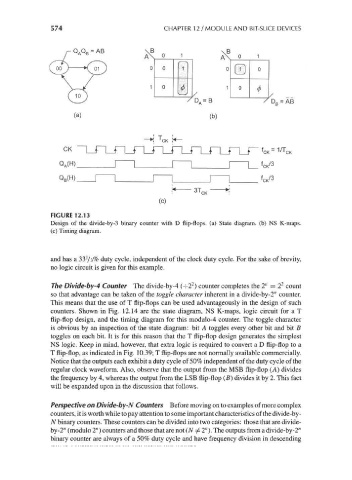
                     FIGURE 12.13
                     Design of the divide-by-3 binary counter with D flip-flops, (a) State diagram, (b) NS K-maps.
                     (c) Timing diagram.


                     and has a 33'/3% duty cycle, independent of the clock duty cycle. For the sake of brevity,
                     no logic circuit is given for this example.


                                                             2
                                                                                       2
                     The Divide-by-4 Counter The divide-by-4 O2 ) counter completes the 2" = 2  count
                     so that advantage can be taken of the toggle character inherent in a divide-by-2" counter.
                     This means that the use of T flip-flops can be used advantageously in the design of such
                     counters. Shown in Fig. 12.14 are the state diagram, NS K-maps, logic circuit for a T
                     flip-flop design, and the timing diagram for this modulo-4 counter. The toggle character
                     is obvious by an inspection of the state diagram: bit A toggles every other bit and bit B
                     toggles on each bit. It is for this reason that the T flip-flop design generates the simplest
                     NS logic. Keep in mind, however, that extra logic is required to convert a D flip-flop to a
                     T flip-flop, as indicated in Fig. 10.39; T flip-flops are not normally available commercially.
                     Notice that the outputs each exhibit a duty cycle of 50% independent of the duty cycle of the
                     regular clock waveform. Also, observe that the output from the MSB flip-flop (A) divides
                     the frequency by 4, whereas the output from the LSB flip-flop (B) divides it by 2. This fact
                     will be expanded upon in the discussion that follows.

                     Perspective on Divide-by-N Counters Before moving on to examples of more complex
                     counters, it is worth while to pay attention to some important characteristics of the divide-by -
                     N binary counters. These counters can be divided into two categories: those that are divide-
                     by-2" (modulo 2") counters and those that are not (N ^ 2"). The outputs from a divide-by-2"
                     binary counter are always of a 50% duty cycle and have frequency division in descending

