


Page 622 - Engineering Digital Design
P. 622
Non-self-correcting
                      PS              NS                  Decimal
                  A  B C D        D A D B D c D D  RL   PS     NS
                  000       0     0   0  0  0    R L     0  -> 0 Hang state       0 -* 1    SL 1
                  0  0  1  1      0   1  1   0   R L     3  -» 6                  3 -» 6 SL O
                  0  1   0  1      1  0  1  0    RL      5  -» 10                 5  -» 10  SLO
                  0  1   1  0      1  1  0  0    RL      6  -» 12                 6 -^ 12   SLO
                  0  1   1  1     1   1  1  0    RL      7  -» 14                 7  -» 14  SLO
                  1  0  0  1      0   0  1   1   R L     9 -* 3                   9^ 2 SL O
                  1  0   1  0     0   1  0  1    RL      10 -» 5                 10 -> 4    SLO
                  101       1     0   1  1  1    RL      11 -» 7                 11 -> 6    SLO
                  1  1   0  0     1 0 0     1    RL     12 -» 9                  12 ^ 8     SLO
                  1  1   0  1     1   0  1  1    RL     13 -» 11                 13 -» 10   SLO
                  1  1   1  0     1   1  0  1    RL     14 -» 13                 14 -» 12   SLO
                  1  1   1  1     1   1  1  1    R L    1 5 -» 1 5 Hang state    1 5 -» 1 4 SL O

                                   RL = Rotate left                                SL = Shift left
                                        (a)                                             (b)
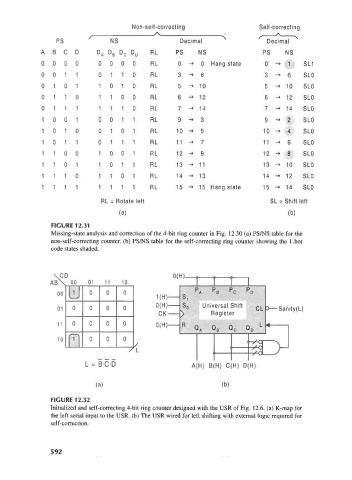
                     FIGURE 12.31
                     Missing-state analysis and correction of the 4-bit ring counter in Fig. 12.30 (a) PS/NS table for the
                     non-self-correcting counter, (b) PS/NS table for the self-correcting ring counter showing the 1-hot
                     code states shaded.


                      \CD                              0(H).
                     AB\ 00     01  11   10
                       00
                          v—/ |    I    I   I      i^n;   1 o 1
                                                   0(H)         Universal Shift
                       01                                                      CL 3—Sanity(L)
                                                    CK-            Register
                       11                          0(H)
                          m
                       10       0    0


                               L = B-C-D                     A(H) B(H) C(H) D(H)


                                  (a)                                 (b)
                     FIGURE 12.32
                     Initialized and self-correcting 4-bit ring counter designed with the USR of Fig. 12.6. (a) K-map for
                     the left serial input to the USR. (b) The USR wired for left shifting with external logic required for
                     self-correction.


                     592

