


Page 659 - Engineering Digital Design
P. 659
13.3  STATE MACHINE DESIGNS CENTERED AROUND A SHIFT REGISTER         629


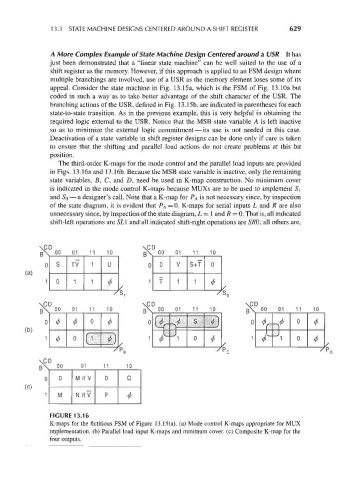
                 A More Complex Example of State Machine Design Centered around a USR It has
                 just been demonstrated that a "linear state machine" can be well suited to the use of a
                 shift register as the memory. However, if this approach is applied to an FSM design where
                 multiple branchings are involved, use of a USR as the memory element loses some of its
                 appeal. Consider the state machine in Fig. 13.15a, which is the FSM of Fig. 13.10a but
                 coded in such a way as to take better advantage of the shift character of the USR. The
                 branching actions of the USR, defined in Fig. 13.15b, are indicated in parentheses for each
                 state-to-state transition. As in the previous example, this is very helpful in obtaining the
                 required logic external to the USR. Notice that the MSB state variable A is left inactive
                 so as to minimize the external logic commitment — its use is not needed in this case.
                 Deactivation of a state variable in shift register designs can be done only if care is taken
                 to ensure that the shifting and parallel load actions do not create problems at this bit
                 position.
                    The third-order K-maps for the mode control and the parallel load inputs are provided
                 in Figs. 13.16a and 13.16b. Because the MSB state variable is inactive, only the remaining
                 state variables, B, C, and D, need be used in K-map construction. No minimum cover
                 is indicated in the mode control K-maps because MUXs are to be used to implement S\
                 and So — a designer's call. Note that a K-map for P A is not necessary since, by inspection
                 of the state diagram, it is evident that PA = 0. K-maps for serial inputs L and R are also
                 unnecessary since, by inspection of the state diagram, L = 1 and R = 0. That is, all indicated
                 shift-left operations are SLl and all indicated shift-right operations are SRO; all others are,


              \CD                          \CD
              p\ 00    01   11  10         p\ 00    01   11   10
               0   S   TV   1    U           0  0    V   S+T   0
          (a)
               1   0    1   1                1 f     1    1
                                 *                            *

              \CD                          \CD                          \CD
              [X 00    01   11   10        g\ 00    01   11   10        R\ 00     01   11  10
                  (f)       0                  I ^        S   ')             VY        0    (f)
                       *         ^                 Y
          (b)                                                                     1
                                                              #
                                                     1
               1^0[        ('    (j) \ j     1^  <-  1 0 0    ^              /-        0    (f)
                       0
                            1 ^
                  (j)
                                                (f)
                                                               ^P,
              \CD
              R\   00     01    11    10
               0   0    M if V  0      Q
          (c)
               11  M    N if V  P
                                       *
                           6
                         13.1
                 FIGUR
                 FIGURE 13.16
                      E
                 K-maps for the fictitious FSM of Figure 13.15(a). (a) Mode control K-maps appropriate for MUX
                 K-maps for
                 implementation, (b) Parallel load input K-maps and minimum cover, (c) Composite K-map for the
                 implemental
                 four outputs

