


Page 205 - Sami Franssila Introduction to Microfabrication
P. 205
184 Introduction to Microfabrication


                                    (a)                                       (b)
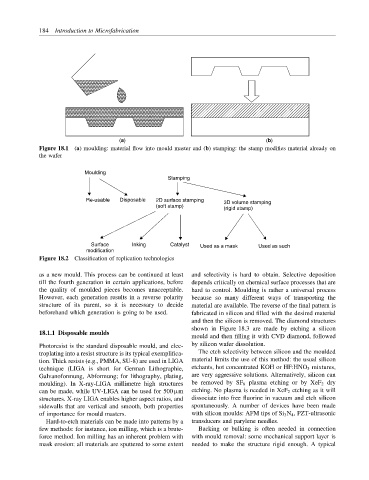
            Figure 18.1 (a) moulding: material flow into mould master and (b) stamping: the stamp modifies material already on
            the wafer

                          Moulding
                                                  Stamping


                          Re-usable  Disposable  2D surface stamping  3D volume stamping
                                              (soft stamp)
                                                                  (rigid stamp)


                           Surface     Inking     Catalyst  Used as a mask  Used as such
                          modification
            Figure 18.2 Classification of replication technologies

            as a new mould. This process can be continued at least  and selectivity is hard to obtain. Selective deposition
            till the fourth generation in certain applications, before  depends critically on chemical surface processes that are
            the quality of moulded pieces becomes unacceptable.  hard to control. Moulding is rather a universal process
            However, each generation results in a reverse polarity  because so many different ways of transporting the
            structure of its parent, so it is necessary to decide  material are available. The reverse of the final pattern is
            beforehand which generation is going to be used.  fabricated in silicon and filled with the desired material
                                                         and then the silicon is removed. The diamond structures
                                                         shown in Figure 18.3 are made by etching a silicon
            18.1.1 Disposable moulds
                                                         mould and then filling it with CVD diamond, followed
            Photoresist is the standard disposable mould, and elec-  by silicon wafer dissolution.
            troplating into a resist structure is its typical exemplifica-  The etch selectivity between silicon and the moulded
            tion. Thick resists (e.g., PMMA, SU-8) are used in LIGA  material limits the use of this method: the usual silicon
            technique (LIGA is short for German Lithographie,  etchants, hot concentrated KOH or HF:HNO 3 mixtures,
            Galvanoformung, Abformung; for lithography, plating,  are very aggressive solutions. Alternatively, silicon can
            moulding). In X-ray-LIGA millimetre high structures  be removed by SF 6 plasma etching or by XeF 2 dry
            can be made, while UV-LIGA can be used for 500 µm  etching. No plasma is needed in XeF 2 etching as it will
            structures. X-ray LIGA enables higher aspect ratios, and  dissociate into free fluorine in vacuum and etch silicon
            sidewalls that are vertical and smooth, both properties  spontaneously. A number of devices have been made
            of importance for mould masters.             with silicon moulds: AFM tips of Si 3 N 4 , PZT-ultrasonic
              Hard-to-etch materials can be made into patterns by a  transducers and parylene needles.
            few methods: for instance, ion milling, which is a brute-  Backing or bulking is often needed in connection
            force method. Ion milling has an inherent problem with  with mould removal: some mechanical support layer is
            mask erosion: all materials are sputtered to some extent  needed to make the structure rigid enough. A typical

