


Page 198 - Plant design and economics for chemical engineers
P. 198
172  PLANT DESIGN AND ECONOMICS FOR CHEMICAL ENGINEERS
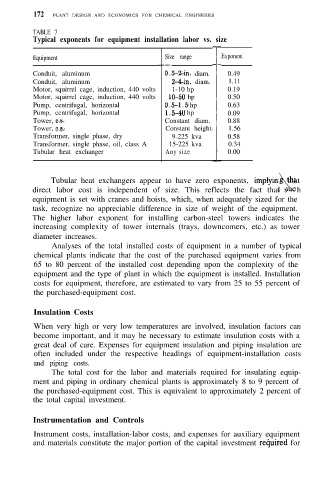
          TABLE 7
          Typical exponents for equipment installation labor vs. size

          Equipment                         Size range    Exponent
                                          .- -          --
          Conduit, aluminum                 0.5-2-in.  diam.  0.49
          Conduit, aluminum                  2-4-in.  diam.  1.11
          Motor, squirrel cage, induction, 440 volts  1-10 hp  0.19
          Motor, squirrel cage, induction, 440 volts  lo-50  hp  0.50
          Pump, centrifugal, horizontal     0.5-1.5  hp     0.63
          Pump, centrifugal, horizontal     1.5-40  hp      0.09
          Tower, C.S.                       Constant diam.  0.88
          Tower, C.S.                       Constant height  1.56
          Transformer, single phase, dry     9-225 kva      0.58
          Transformer, single phase, oil, class A  15-225 kva  0.34
          Tubular heat exchanger            Any  size       0.00
                                                        :

              Tubular heat exchangers appear to have zero exponents, implyin  that
                                                                         k h
         direct labor cost is independent of size. This reflects the fact that  s
         equipment is set with cranes and hoists, which, when adequately sized for the
         task, recognize no appreciable difference in size of weight of the equipment.
         The higher labor exponent for installing carbon-steel towers indicates the
          increasing complexity of tower internals (trays, downcomers, etc.) as tower
          diameter increases.
              Analyses of the total installed costs of equipment in a number of typical
          chemical plants indicate that the cost of the purchased equipment varies from
          65 to 80 percent of the installed cost depending upon the complexity of the
          equipment and the type of plant in which the equipment is installed. Installation
          costs for equipment, therefore, are estimated to vary from 25 to 55 percent of
          the purchased-equipment cost.


          Insulation Costs
          When very high or very low temperatures are involved, insulation factors can
          become important, and it may be necessary to estimate insulation costs with a
          great deal of care. Expenses for equipment insulation and piping insulation are
          often included under the respective headings of equipment-installation costs
          and piping costs.
              The total cost for the labor and materials required for insulating equip-
          ment and piping in ordinary chemical plants is approximately 8 to 9 percent of
          the purchased-equipment cost. This is equivalent to approximately 2 percent of
          the total capital investment.

          Instrumentation and Controls
          Instrument costs, installation-labor costs, and expenses for auxiliary equipment
          and materials constitute the major portion of the capital investment re@ired  for

