


Page 159 - Rashid, Power Electronics Handbook
P. 159
148                                                                                 Y.-S. Lee and M. Chow


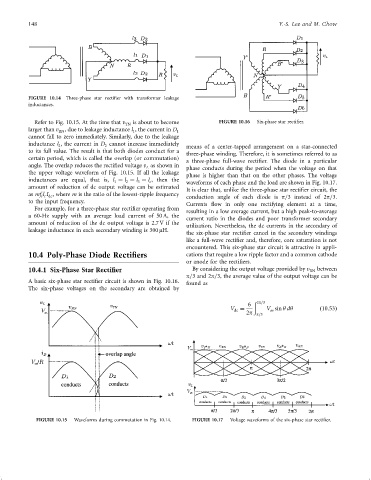
               FIGURE 10.14  Three-phase star recti®er with transformer leakage
               inductances.

                 Refer to Fig. 10.15. At the time that v  is about to become   FIGURE 10.16  Six-phase star recti®er.
                                                YN
               larger than v  , due to leakage inductance l , the current in D
                          RN                      1              1
               cannot fall to zero immediately. Similarly, due to the leakage
               inductance l , the current in D cannot increase immediately  means of a center-tapped arrangement on a star-connected
                         2
                                         2
               to its full value. The result is that both diodes conduct for a
                                                                    three-phase winding. Therefore, it is sometimes referred to as
               certain period, which is called the overlap (or commutation)
                                                                    a three-phase full-wave recti®er. The diode in a particular
               angle. The overlap reduces the recti®ed voltage v as shown in  phase conducts during the period when the voltage on that
                                                       L
               the upper voltage waveform of Fig. 10.15. If all the leakage  phase is higher than that on the other phases. The voltage
               inductances are equal, that is, l ¼ l ¼ l ¼ l , then the  waveforms of each phase and the load are shown in Fig. 10.17.
                                                    3
                                                        c
                                            1
                                                2
               amount of reduction of dc output voltage can be estimated
                                                                    It is clear that, unlike the three-phase star recti®er circuit, the
               as mf l I , where m is the ratio of the lowest-ripple frequency  conduction angle of each diode is p=3 instead of 2p=3.
                    i c dc
               to the input frequency.
                                                                    Currents ¯ow in only one rectifying element at a time,
                 For example, for a three-phase star recti®er operating from
                                                                    resulting in a low average current, but a high peak-to-average
               a 60-Hz supply with an average load current of 50 A, the
                                                                    current ratio in the diodes and poor transformer secondary
               amount of reduction of the dc output voltage is 2.7 V if the
                                                                    utilization. Nevertheless, the dc currents in the secondary of
               leakage inductance in each secondary winding is 300 mH.
                                                                    the six-phase star recti®er cancel in the secondary windings
                                                                    like a full-wave recti®er and, therefore, core saturation is not
                                                                    encountered. This six-phase star circuit is attractive in appli-
               10.4 Poly-Phase Diode Rectifiers                      cations that require a low ripple factor and a common cathode
                                                                    or anode for the recti®ers.
               10.4.1 Six-Phase Star Rectifier                         By considering the output voltage provided by v RN  between
                                                                    p=3 and 2p=3, the average value of the output voltage can be
               A basic six-phase star recti®er circuit is shown in Fig. 10.16.
                                                                    found as
               The six-phase voltages on the secondary are obtained by
                                                                                          ð 2p=3
                                                                                         6
                                                                                   V ¼         V sin y dy        ð10:53Þ
                                                                                                m
                                                                                    dc
                                                                                        2p  p=3


                  FIGURE 10.15  Waveforms during commutation in Fig. 10.14.  FIGURE 10.17  Voltage waveforms of the six-phase star recti®er.

