


Page 242 - Fluid Power Engineering
P. 242
Basics of Electricity and Generators     209


                                                                 2
                     3           3 E 2 g     3         2       3i Z
                                                                 g
                P g =  V g E g sin δ =  sin 2δ =  (K pm ω r p) sin 2δ =
                     Z           2 Z         8Z                tan δ
                                                                 (10-33)
                        3       2          3  2
                   τ g =  (K pm p) ω r sin 2δ =  K pm  p sin 2δ = T max sin 2δ
                        8Z                4L
                                  2
                          2
                         3i Z    3i Lp
                          g       g
                     =        =                                  (10-34)
                        ω r tan δ  2 tan δ
              where Z = ωL is the inductance of the stator. The angular frequency
              of generator current is ω = pω r /2, where ω r is the angular speed of
              the rotor.
                 Variable-speed generators will generate voltage and current that
              vary in magnitude and frequency, unlike the constant voltage and
              frequency of the grid. Therefore, the voltage and frequency from these
              generators is conditioned to be compatible with the grid by converting
              from variable AC to DC and then back to constant frequency and
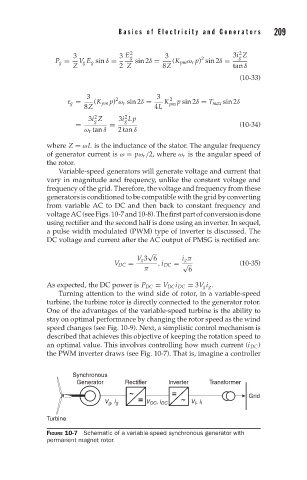
              voltageAC(seeFigs.10-7and10-8).Thefirstpartofconversionisdone
              using rectifier and the second half is done using an inverter. In sequel,
              a pulse width modulated (PWM) type of inverter is discussed. The
              DC voltage and current after the AC output of PMSG is rectified are:
                                        √
                                      V g 3 6     i g π
                                V DC =     , i DC = √            (10-35)
                                        π          6
              As expected, the DC power is P DC = V DC i DC = 3V g i g .
                 Turning attention to the wind side of rotor, in a variable-speed
              turbine, the turbine rotor is directly connected to the generator rotor.
              One of the advantages of the variable-speed turbine is the ability to
              stay on optimal performance by changing the rotor speed as the wind
              speed changes (see Fig. 10-9). Next, a simplistic control mechanism is
              described that achieves this objective of keeping the rotation speed to
              an optimal value. This involves controlling how much current (i DC )
              the PWM inverter draws (see Fig. 10-7). That is, imagine a controller

                    Synchronous
                      Generator   Rectifier   Inverter   Transformer
                                    ~          =                    Grid
                                      =          ~
                             V g , i g  V DC , i DC  V I , i I

              Turbine
              FIGURE 10-7 Schematic of a variable-speed synchronous generator with
              permanent magnet rotor.

