


Page 482 - Engineering Digital Design
P. 482
452     CHAPTER 10 / INTRODUCTION TO SYNCHRONOUS STATE MACHINE DESIGN


                                                                      State
                                                                     variable Input logic
                                                          State      change  value
                                                         variable, Q
                                                                   Q. t

                                                                             0 Reset Hold
                              Q, Hold
                                                                   0 -»• 1   1
                              Q, Toggle                                         Toggle
                                                                   1 -»• 0   1
                          Operation               (^ 1 ^ Q,it      1         0 Set Hold
                           Table
                                                                     Excitation
                             (a)                    f                  Table
                                                  State                 (c)
                                                 Diagram
                                                   (b)
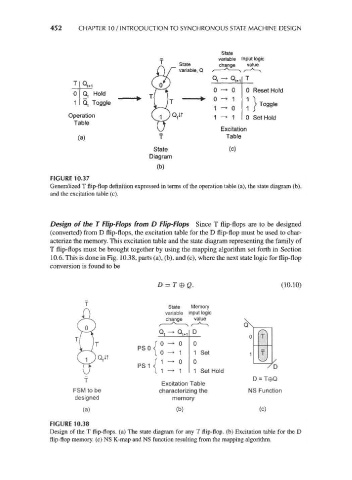
                     FIGURE 10.37
                     Generalized T flip-flop definition expressed in terms of the operation table (a), the state diagram (b),
                     and the excitation table (c).


                     Design of the T Flip-Flops from D Flip-Flops  Since T flip-flops are to be designed
                     (converted) from D flip-flops, the excitation table for the D flip-flop must be used to char-
                     acterize the memory. This excitation table and the state diagram representing the family of
                     T flip-flops must be brought together by using the mapping algorithm set forth in Section
                     10.6. This is done in Fig. 10.38, parts (a), (b), and (c), where the next state logic for flip-flop
                     conversion is found to be


                                                   D = T®Q.                            (10.10)


                                                      State  Memory
                                                     variable input logic
                                                     change  value
                                                   Q         D

                                                             0
                                             PSO<°^ °  1Q t
                                                    0 -* 1   1 Set
                                                    1 -> 0
                                             PS 1 <! '   "   °
                                                    1 -> 1   1 Set Hold
                                                    Excitation Table
                                                   characterizing the
                                                       memory
                                                        (b)                     (c)
                     FIGURE 10.38
                     Design of the T flip-flops, (a) The state diagram for any T flip-flop, (b) Excitation table for the D
                     flip-flop memory, (c) NS K-map and NS function resulting from the mapping algorithm.

