


Page 728 - Engineering Digital Design
P. 728
694        CHAPTER 14/ASYNCHRONOUS STATE MACHINE DESIGN AND ANALYSIS


                                   S(L)    1      I            1        '
                                   R(L)                                 i
                                                                        1           '
                                         — M             •+•
                                   Q(H)    _l             ^J            HnJT^r^
                                                                         I
                                           -*- U-T     -* ^— T                _^ ^_ T
                                             '   P           P           •          P
                                   P(L)      1                           n n n n n
                                                                Loss of mixed-  Oscillation
                                                                 rail outputs
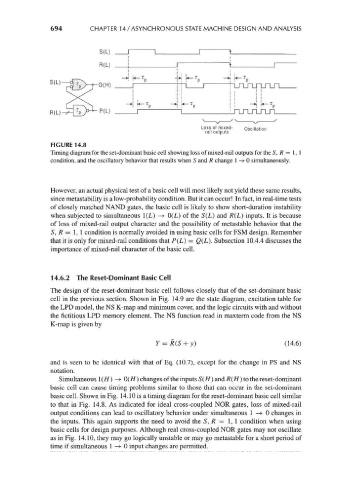
                    FIGURE 14.8
                    Timing diagram for the set-dominant basic cell showing loss of mixed-rail outputs for the 5, R = 1, 1
                    condition, and the oscillatory behavior that results when S and R change 1—^-0 simultaneously.


                    However, an actual physical test of a basic cell will most likely not yield these same results,
                    since metastability is a low-probability condition. But it can occur! In fact, in real-time tests
                    of closely matched NAND gates, the basic cell is likely to show short-duration instability
                    when subjected to simultaneous 1(L) -> 0(L) of the S(L) and R(L) inputs. It is because
                    of loss of mixed-rail output character and the possibility of metastable behavior that the
                    S, R = 1, 1 condition is normally avoided in using basic cells for FSM design. Remember
                    that it is only for mixed-rail conditions that P(L) = Q(L). Subsection 10.4.4 discusses the
                    importance of mixed-rail character of the basic cell.


                    14.6.2 The Reset-Dominant Basic Cell
                    The design of the reset-dominant basic cell follows closely that of the set-dominant basic
                    cell in the previous section. Shown in Fig. 14.9 are the state diagram, excitation table for
                    the LPD model, the NS K-map and minimum cover, and the logic circuits with and without
                    the fictitious LPD memory element. The NS function read in maxterm code from the NS
                    K-map is given by

                                                  Y = R(S + y)                         (14.6)


                    and is seen to be identical with that of Eq. (10.7), except for the change in PS and NS
                    notation.
                      Simultaneous !(//) —>• 0(//) changes of the inputs S(H) and R(H) to the reset-dominant
                    basic cell can cause timing problems similar to those that can occur in the set-dominant
                    basic cell. Shown in Fig. 14.10 is a timing diagram for the reset-dominant basic cell similar
                    to that in Fig. 14.8. As indicated for ideal cross-coupled NOR gates, loss of mixed-rail
                    output conditions can lead to oscillatory behavior under simultaneous 1 —> 0 changes in
                    the inputs. This again supports the need to avoid the S, R — 1,1 condition when using
                    basic cells for design purposes. Although real cross-coupled NOR gates may not oscillate
                    as in Fig. 14.10, they may go logically unstable or may go metastable for a short period of
                    time if simultaneous 1 -> 0 input changes are permitted.

