


Page 500 - Industrial Power Engineering and Applications Handbook
P. 500
15/474  Industrial Power Engineering and Applications Handbook
           at least sufficient to operate the relay. At a 40% setting,
           for instance, the CT must have a VA of (U0.4 I)2 or
           6.25 times the VA of the relay and at a setting of 20%,
           (U0.2 I)’  or 25 times of the relay. Therefore when the
           relay setting is low this must be borne in mind and a
           CT of  a  higher  VA  burden  be  chosen.  Such  a
           consideration, however, is more pertinent in the case
           of electro-magnetic relays that have a high VA level
           than  in  electrostatic  (electronic)  relays  that  have  a
           near negligible VA level at only around 0.005 VA.
          Where  three  CTs  for  unrestricted  or  four  CTs  for
        restricted  ground  fault  or  combined  OK and  G/F
        protections  are employed in  the  protective  circuit, the
        VA burden of the relay is shared by all the CTs in parallel
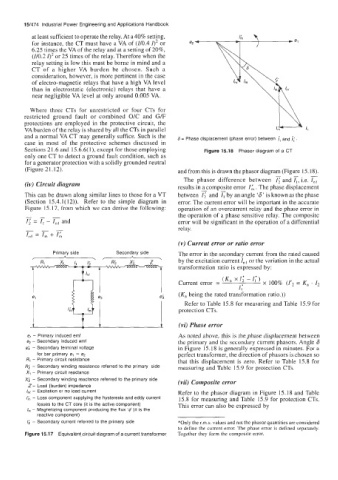
        and a normal VA CT may generally suffice. Such is the   6 = Phase displacement (phase error) between  i, and I;.
        case  in  most  of  the  protective  schemes  discussed  in
        Sections 21.6 and 15.6.6(1), except for those employing   Figure 15.18  Phasor diagram of  a CT
        only one CT to detect a ground fault condition, such as
        for a generator protection with a solidly grounded neutral
         (Figure 21.12).                               and from this is drawn the phasor diagram (Figure 15.18).
                                                                                          -
                                                         The  phasor  difference  between  zand I,, i.e.
         (iv) Circuit diagram                          results in a composite error  I;.  The phase displacement
        This can be drawn along similar lines to those for a VT   between   and 7; by an angle ‘6’ is known as the phase
         (Section  15.4.1(12)).  Refer  to  the  simple diagram  in   error. The current error will be important in the accurate
         Figure 15.17, from which we can derive the following:   operation of an overcurrent relay and the phase error in
                                                       the operation of  a phase sensitive relay. The composite
         E= 7;- Land                                   error will be significant in the operation of a differential
         ---                                           relay.
         I,,  = I,  4-  I;
                                                       (v) Current error or ratio error
                 Primary side       Secondary side   .   The error in the secondary current from the rated caused
                    A        ..,         A
                                r
                                   R;   X;     Z       by the excitation current I,, or the variation in the actual
                                                       transformation ratio is expressed by:
                                                                     (K, xr; -1;)
                                                       Current  error  =         x 100% (1’2  = K,  . 12
                                                  l                       I;
                                                  e;   (K, being the rated transformation ratio.))
                                                         Refer to Table 15.8 for measuring and Table 15.9 for
                                                       protection CTs.

           t                   t                  t    (vi) Phase error
         e, - Primary induced emf                      As noted above, this is the phase displacement between
         4 - Secondary  induced emf                    the primary and the secondary current phasors. Angle 6
         e; - Secondary terminal voltage               in Figure 15.18 is generally expressed in minutes. For a
             for bar primary e, = e,                   perfect transformer, the direction of phasors is chosen so
         R, - Primary circuit  resistance              that  this displacement  is zero. Refer to Table  15.8 for
         R;  - Secondary winding  resistance referred to the primary  side   measuring and Tablc 15.9 for protection CTs.
         X,  - Primary circuit  reactance
         X;  - Secondary winding reactance referred to the primary side   (vii) Composite error
          Z- Load (burden) impedance
         /,,(  - Excitation or no load current         Refer to the phasor diagram in Figure  15.18 and Table
         /&  - Loss component supplying the hysteresis and eddy current   15.8 for measuring and Table  15.9 for protection  CTs.
             losses to the CT core (it is the active component)   This error can also be expressed by
         /m  - Magnetizing component producing the flux ‘4’ (it is the
             reactive component)
         1;  - Secondary current referred to the primary side   *Only the r.m.s. values and not the phasor quantities are considered
                                                       to define the current error. The phase error is defined separately.
         Figure 15.17  Equivalent circuit diagram of a current transformer   Together they  form the composite error.

