


Page 185 - Microsensors, MEMS and Smart Devices - Gardner Varadhan and Awadelkarim
P. 185
165

       3.  About  600  nm  of  borophosphosilicate  glass  (BPSG)  is  deposited  at  400 °C.  BPSG
          serves  as  an  interlevel  dielectric  between  the  poly-Si  gate  and  metal  and  is  also  a
          sacrificial layer that sets the gap. The BPSG  is then patterned  and plasma-etched using
          CF4 that is timed  to  stop  at  Si3N4  because  CF4 also etches  Si 3N 4  (Figure  6.18(c)).
       4.  A  1 um  layer  of  poly-Si  is  deposited  by  LPCVD  at  625 °C, doped  with  phosphorus
          using  a  POC1 3  source  at  925 °C,  and  the  phosphorus  glass  wet-etched.  A  front-coat
          resist is applied  and  a backside  poly-Si  plasma  etch  is performed  using SFf,  stopping
          on the  BPSG  layer. The poly-Si layer  serves  as the top plate  of the  air gap  capacitor
          and  is  patterned or  plasma-etched  in  CC1 4  (Figure 6, 1 8(d)).
       5.  After  etching,  the  process  returns  to  a  normal  back-end  MOS  process  that  consists
          of patterning or etching contact cuts into the BPSG,  followed by a sputter deposition
          of  aluminum (with  1 percent  Si)  to  a  thickness of  1.1 um.  The  metal  is  patterned,
          plasma-etched,  and  sintered  to  complete  the  front-side processing  (Figure  6.18(e)).
          The  contact  to the n +  bottom  plate  is  made  via n +  diffusion  channels  contacted  by
          the  metal  that surrounds the  diaphragm.  Contact  to  the  poly-Si is  made directly via
          metal  on  top  of  a  tab that protrudes  from  the  square structure.

       Process Flow  (B):  Backside  Processing
        1 .  Back-to-front infrared  alignment is made  via two mask-plates  in a double-sided  mask
          aligner. After photolithography, the backside is plasma-etched in CH4, removing both
          the  BPSG  and  the  nitride in  one  step.
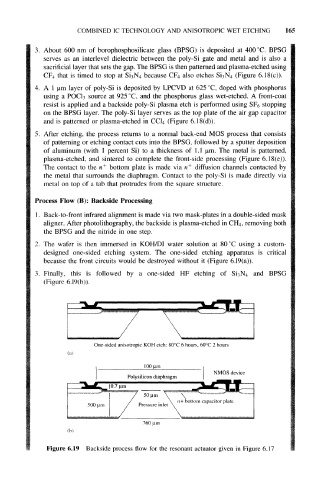
       2.  The  wafer  is  then  immersed  in  KOH/DI  water  solution  at  80 °C  using  a custom-
          designed  one-sided  etching  system.  The  one-sided  etching  apparatus  is  critical
          because  the  front  circuits would be  destroyed  without it  (Figure 6.19(a)).
       3.  Finally,  this  is  followed  by  a  one-sided  HF  etching  of  and  BPSG
          (Figure  6.19(b)).


                        One-sided anisotropic KOH etch: 80°C  6 hours, 60°C 2 hours

                                      100 u


                                     50 um  \   \
                                            \  n+ bottom capacitor plate
                      500 um        Pressure inlet  x
                                     760 um


           Figure  6.19  Backside process  flow  for  the resonant actuator given in Figure 6.17

