Page 293 - Power Electronic Control in Electrical Systems
P. 293
//SYS21/F:/PEC/REVISES_10-11-01/075065126-CH007.3D ± 281 ± [263±289/27] 17.11.2001 10:25AM


                                                            Power electronic control in electrical systems 281

                      the network equivalent impedance. This is at least the case for well-designed TCSCs
                      operating in capacitive mode. Measurements conducted in both the Slatt and the
                      Kayenta TCSC systems support this observation. For instance, the Kayenta system
                      generates at its terminals, a maximum THD voltage of 1.5% when operated in
                      capacitive mode and firing at an angle of 147 (Christl et al., 1991). It should be

                      noted that there is little incentive for operating the TCSC in inductive mode since this
                      would increase the electrical length of the compensated transmission line, with
                      adverse consequences on stability margins and extra losses.
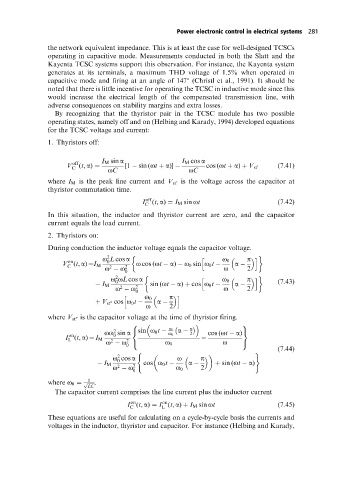
                        By recognizing that the thyristor pair in the TCSC module has two possible
                      operating states, namely off and on (Helbing and Karady, 1994) developed equations
                      for the TCSC voltage and current:
                      1. Thyristors off:

                                      I M sin a              I M cos a
                            V off (t, a) ˆ  oC  [1   sin (ot ‡ a)]    oC  cos (ot ‡ a) ‡ V st 0  (7:41)
                             C
                      where I M is the peak line current and V st is the voltage across the capacitor at
                                                           0
                      thyristor commutation time.
                                                  I C off (t, a) ˆ I M sin ot            (7:42)
                      In this situation, the inductor and thyristor current are zero, and the capacitor
                      current equals the load current.

                      2. Thyristors on:
                      During conduction the inductor voltage equals the capacitor voltage.
                                       2
                                      o L cos a                    h            p  i
                            on         0                                 o 0
                          V (t, a) ˆI M         o cos (ot   a)   o 0 sin o 0 t    a
                            C                2
                                        2
                                       o   o 0                           o      2
                                          2
                                        o oL cos a                 h     o 0     p  i    (7:43)
                                          0
                                      I M       2   sin (ot   a) ‡ cos o 0 t    a
                                           2
                                          o   o 0                        o      2
                                            h            p  i
                                                  o 0
                                    ‡ V st cos o 0 t    a
                                        00
                                                   o      2
                      where V st is the capacitor voltage at the time of thyristor firing.
                              00

                                               8                               9
                                                         o     p
                                         2
                                       oo sin a  < sin o 0 t    a    2  cos (ot   a) =
                            on           0               o 0
                           I (t, a) ˆ I M  2  2                          o
                            L
                                             0
                                       o   o :          o 0                    ;
                                                                                         (7:44)
                                                (                                 )
                                         o cos a            o      p
                                          2
                                          0
                                      I M      2  cos o 0 t    a       ‡ sin (ot   a)
                                          2
                                         o   o 0           o 0     2
                                  1
                      where o 0 ˆ .
                                 p
                                  LC
                        The capacitor current comprises the line current plus the inductor current
                                              on
                                                       on
                                             I (t, a) ˆ I (t, a) ‡ I M sin ot            (7:45)
                                              C        L
                      These equations are useful for calculating on a cycle-by-cycle basis the currents and
                      voltages in the inductor, thyristor and capacitor. For instance (Helbing and Karady,
   288   289   290   291   292   293   294   295   296   297   298